
Launch HN: Indy (YC S21) – A support app designed for ADHD brains
christalwang Friday, January 16, 2026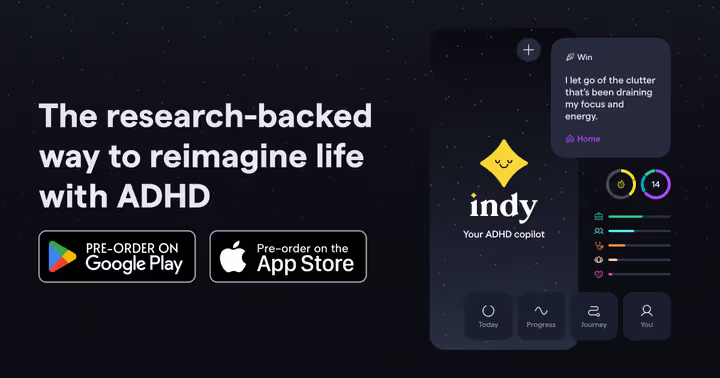
Hi I’m Chris, one of the co-founders of Shimmer, and today we’re launching our new app called Indy (https://www.shimmer.care/indy). Indy is an ADHD app for structured planning, reflection, and self-awareness exercises. Here’s a demo: https://www.youtube.com/watch?v=zDSDxyXv6i4.
We started Shimmer in 2022 after my adult ADHD diagnosis, and have shipped several iterations of ADHD support since then (1:1 coaching, web tools, body doubling, and AI-assisted coaching).
Across these launches and 80k coaching sessions, we kept running into the same constraint: “knowing what to do” is rarely the problem for people with ADHD. The harder problem is actually doing it consistently over time, especially when attention, motivation, and emotional state fluctuate.
That maps to a useful distinction that is explored in the literature (e.g. https://pmc.ncbi.nlm.nih.gov/articles/PMC4589250/): “cool” executive function (future-oriented planning, direction, values) vs. “hot” executive function (in-the-moment emotion, urgency, impulse, overwhelm). Most tools lean hard into managing the latter. Productivity apps push execution, general chatbots give advice, but neither reliably supports the interaction between hot + cold EF across weeks and months.
So we built Indy, an AI support system designed to support both. Here’s an overview of how it works:
Guided future mapping: users are guided to create a structured map of meaningful past experiences, current priorities, and upcoming future moments. This becomes the foundation for personalization so that everything that they do in the app helps move them closer to these goals
Daily + weekly check-ins: users engage in short, low-friction chat flows to set their priorities for the day (most popular use case is brain dumping priorities then having Indy help sort through them). The system does not assume consistency or linear progress, and adapts prompts based on prior behavior rather than enforcing a fixed routine.
Longitudinal insights: over time, Indy surfaces patterns across inputs so users can see trends in effort, focus, and blockers. This helps counter the common ADHD experiences of 1) forgetting what works / doesn’t work, and 2) feeling like “nothing changed”
Problem-solving when stuck: when users report feeling blocked, Indy uses structured, behavior-change-informed prompts to help identify what is actually getting in the way (e.g. energy, clarity, emotional load, environment) and narrow toward a concrete next step
Progress that includes effort: Indy tracks wins, effort, and insights separately, and helps users draw out positive ways that members showed up (e.g. effort, mindset) even on days where no objective outcome was achieved
Why use AI to do this? and why now? Two main reasons: (1) Affordability: Although continuous human support would mostly be better than a tech solution, that level of availability is too expensive for most people. Even weekly coaching (our core product) is still too expensive for many people. A tech solution allows some support rather than none. (2) Personalization: AI makes it possible to build systems that maintain continuity, personalize over time, and respond to context without relying on rigid templates or requiring constant human presence.
The main challenge we’ve experienced using AI for Indy is preventing it from collapsing into generic advice, productivity pressure, or over-automation/reliance. Instead, we’ve focused on using AI as scaffolding and capacity-building: something that supports reflection, problem solving, and accountability, while keeping agency with the user and clear boundaries around non-medical use.
Indy is free to try: https://www.shimmer.care/indy
If you’re building in applied AI, and/or if you have ADHD, we’d love to know: - what other AI tools you’ve tried for ADHD and things you liked vs. felt missing; -how you think about the role of AI vs. human support for ADHD in your life; - how the onboarding and first-use feels and any positive or critical feedback you have.
I’d love to hear your (ADHD) experiences or feedback on Indy.